
In this article
- Cartilage Damage and Arthritis Are Not the Same Condition
- Why Early Diagnosis Opens More Treatment Options
- How Symptoms Overlap and Where They Differ
- What MRI Reveals That X-rays Cannot
- Why Active Patients Benefit From Specialized Evaluation
- How Cartilage Restoration Decisions Are Made
- When Arthritis Is Already Present
- Frequently Asked Questions
- Resources
Cartilage damage and arthritis are different diagnoses: a focal cartilage injury affects one area of an otherwise healthy joint, while osteoarthritis is a progressive disease of the whole joint. The distinction matters because focal defects can often be treated with joint-preserving options that become less effective once arthritis is widespread. MRI and specialist evaluation, not symptoms alone, are what tell the two apart.
Knee pain is often labeled “arthritis” even when that isn’t the underlying problem. For many active adults, athletes, and younger patients, the source is a focal cartilage injury. That is a distinct condition, and it calls for a very different treatment strategy. Telling the two apart early can preserve joint health and keep more treatment options available. In some cases it can also delay the onset of arthritis.
Cartilage Damage and Arthritis Are Not the Same Condition
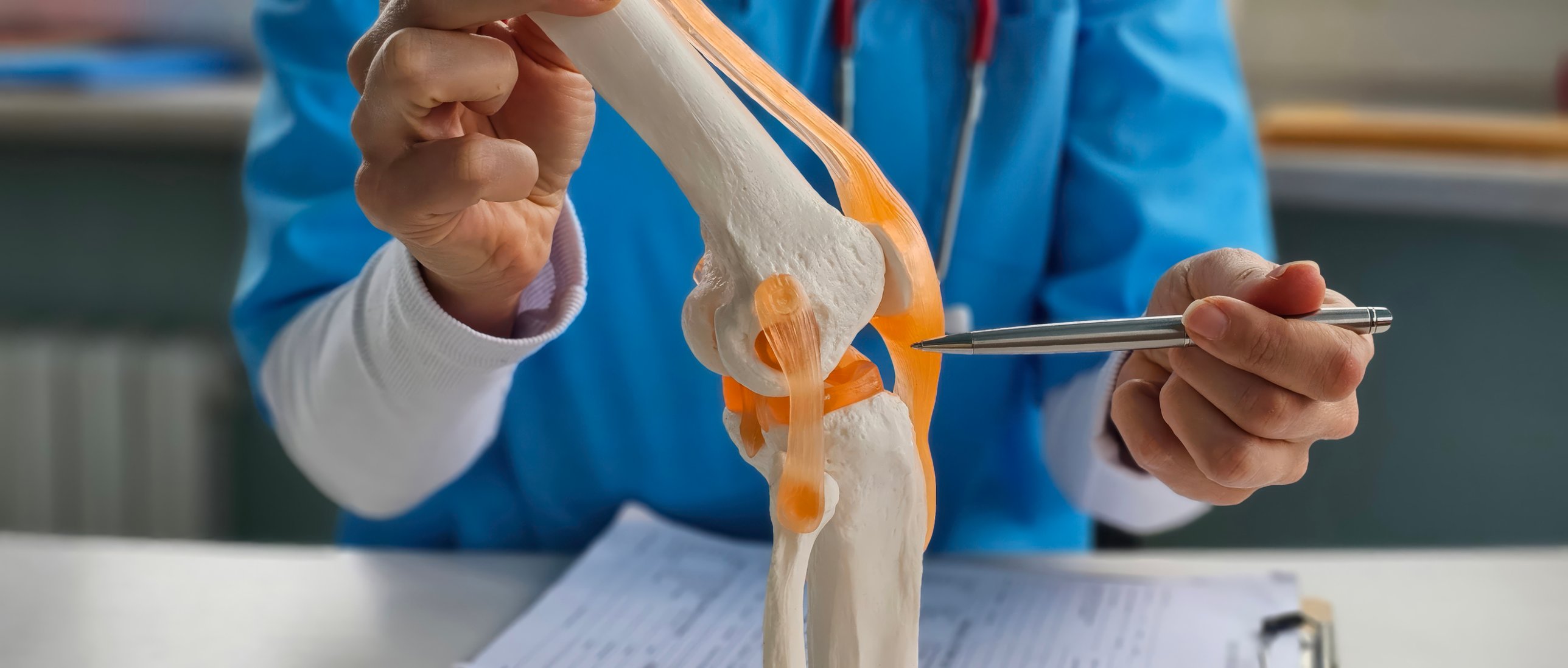
Both conditions involve articular cartilage, the smooth tissue covering the ends of bones inside a joint. But they are fundamentally different diagnoses.
A focal cartilage injury is damage confined to one specific area of that surface. It may follow sports trauma, repetitive loading, or joint instability, and the surrounding cartilage can remain healthy.
Osteoarthritis is a progressive disease. It involves widespread cartilage degeneration, changes in the underlying bone, inflammation, and gradual loss of joint function.
The two terms are often used interchangeably. Early evaluations sometimes describe cartilage wear as “arthritis” without saying whether the damage is localized or diffuse. That distinction drives nearly every treatment decision that follows.
Why Early Diagnosis Opens More Treatment Options
Focal cartilage defects are often treatable before widespread arthritis develops, and the range of restorative options has grown considerably over the past several decades. Depending on the injury and the patient, options may include:
- Activity modification and physical therapy
- Biologic therapies in appropriate candidates
- Cartilage restoration procedures
- Osteochondral grafting
- Autologous cartilage restoration techniques
- Alignment correction when necessary
As arthritis progresses, many of these joint-preserving procedures become less effective, because the damage is no longer confined to one area.
How Symptoms Overlap and Where They Differ
Both conditions can cause joint pain, swelling, stiffness, clicking or catching, and reduced tolerance for activity. That shared list is why one is so easily mistaken for the other.
Research co-authored by Brian J. Cole MD, MBA compared age-matched patients with focal cartilage defects to patients with knee osteoarthritis. The osteoarthritis group reported more severe symptoms overall. They more often had pain on the inner side of the knee and knee swelling. They also had more pain when straightening the knee, standing upright, or rising from a seated position. These patterns can offer clues, but the overlap is wide enough that symptoms alone cannot settle the diagnosis. Imaging and specialist evaluation are what separate the two.
What MRI Reveals That X-rays Cannot
Standard X-rays remain an important first step, particularly for evaluating arthritis through joint space narrowing and bone changes. Cartilage itself, however, does not show up well on conventional X-rays.
When cartilage injury is suspected, MRI plays a much larger role. It can assess cartilage thickness and focal defects, bone marrow changes, and associated meniscus, ligament, and soft tissue injuries.
Dr. Cole has also co-authored research describing quantitative MRI techniques that evaluate cartilage composition. These techniques add information beyond what standard sequences show about cartilage structure. Earlier detection creates the opportunity for earlier intervention.
Why Active Patients Benefit From Specialized Evaluation
A localized cartilage injury that barely affects daily walking can become very noticeable during running, pivoting sports, squatting, jumping, hiking, or weight training. That is why sports medicine specialists approach focal cartilage injuries differently than advanced arthritis. The goal is not only pain relief but also preserving healthy joint tissue and returning patients safely to the activities they value.
How Cartilage Restoration Decisions Are Made
Cartilage restoration has become one of the fastest-evolving areas of orthopedic sports medicine. Dr. Cole is Section Head of the Cartilage Research and Restoration Center at Rush University Medical Center. He has built an extensive body of published research on cartilage biology, imaging, surgical decision-making, transplantation, biologic augmentation, and long-term outcomes.
That work has helped define when specific procedures are appropriate. These include osteochondral allograft transplantation, microfracture, cartilage implantation, and biologic reconstruction. The decision depends on defect size and location, activity demands, alignment, meniscal health, and overall joint condition, rather than chronological age alone.
The research also reinforces a whole-joint principle. Malalignment, meniscal injury, and ligament deficiency generally need to be corrected, either at the same time or in stages, for a cartilage repair to hold up.
When Arthritis Is Already Present
An arthritis diagnosis does not necessarily eliminate every option. Many patients with early or moderate arthritis still benefit from comprehensive conservative management. That can include physical therapy, weight optimization, activity modification, injection therapies, bracing, and orthobiologic treatments in selected cases.
For some patients, joint-preserving procedures remain appropriate, depending on the pattern and severity of cartilage loss. Treatment should rest on careful evaluation, not on assumptions drawn from age or imaging alone. If persistent knee pain is limiting activity, requesting an appointment online for a comprehensive orthopedic evaluation can clarify the diagnosis and the most appropriate path forward.
Frequently Asked Questions
Is cartilage damage the same as arthritis?
No. Cartilage damage usually refers to a localized injury affecting one area of cartilage. Osteoarthritis is a progressive condition involving widespread joint degeneration.
Can cartilage damage heal without surgery?
Some small injuries improve with activity modification, rehabilitation, and other conservative treatment. Larger defects may require cartilage restoration procedures, depending on symptoms and activity level.
What imaging test best detects cartilage damage?
MRI is generally the most useful study, because it shows cartilage and the surrounding soft tissues in detail.
Can untreated cartilage damage become arthritis?
It can. Some untreated cartilage injuries progress over time and contribute to joint degeneration, although progression varies between individuals.
Who should see a cartilage specialist?
Patients with persistent joint pain, swelling, mechanical symptoms, or ongoing limitations despite conservative treatment may benefit from evaluation by an orthopedic sports medicine specialist experienced in cartilage preservation.
Medical Disclaimer: This information is for educational purposes only and does not constitute medical advice. For diagnosis and treatment recommendations, please consult with Dr. Cole or another qualified orthopedic specialist at Midwest Orthopaedics at Rush.
Resources
Farr J et al. 2011. Clinical cartilage restoration: evolution and overview. Clinical Orthopaedics and Related Research. https://doi.org/10.1007/s11999-010-1764-z
Gilat R et al. 2021. Understanding the difference between symptoms of focal cartilage defects and osteoarthritis of the knee: a matched cohort analysis. International Orthopaedics. https://doi.org/10.1007/s00264-020-04919-w
Moran CJ et al. 2014. Restoration of articular cartilage. The Journal of Bone and Joint Surgery. American Volume. https://doi.org/10.2106/JBJS.L.01329